About
Parks was born in 1942, a little more than a month after Pearl Harbor, and Ginger was born a little more than a year later.
We are now at a point in our lives when we find ourselves looking both backward and forward—at the world we inherited, the changes we have witnessed over more than eight decades, and the world our children and grandchildren will inherit from us.
We grew up with Japanese American friends whose families had been incarcerated during World War II. We spent time on school basement floors, face down, practicing air-raid drills and fearing bombs. We lived through the Cold War, the Korean and Vietnam wars, the Cuban Missile Crisis, political assassinations and Kent State. We watched the September 11 attacks unfold in real time and drove home from halfway across the country to a changed world. Decades later, we watched as the United States Capitol was breached on January 6, 2021.
But our lifetimes have also been a period of extraordinary progress.
We witnessed the desegregation of schools and neighborhoods, the expansion of civil and voting rights, greater rights and opportunities for women, advances in public health and medicine, stronger environmental and workplace protections, and greater legal recognition and protection for people who had previously been excluded.
Those changes did not happen on their own. People worked for them, marched for them, voted for them and, at times, gave their lives for them.
Today, we are concerned that many of the rights, protections, institutions and expectations we saw built during our lifetimes are being challenged, weakened or reversed. We are concerned about the direction of our government, our environment, public health, personal freedoms, and the increasingly divisive culture in which our children and grandchildren will live.
COMMIT AND VOTE grew out of those concerns.
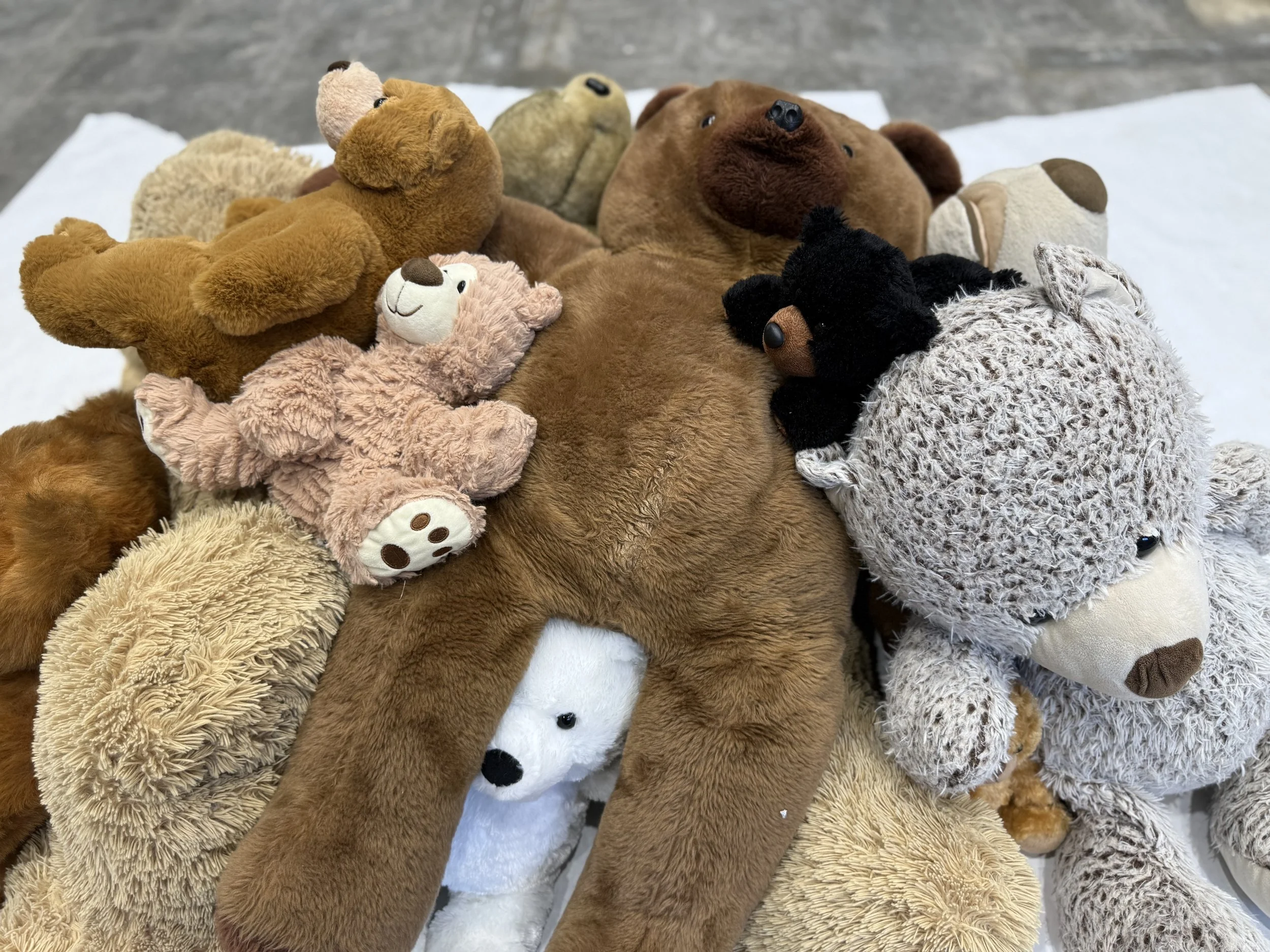
Parks began making this body of work using objects largely found discarded at Goodwill and other everyday materials. Teddy bears, toy guns, dolls, flags, phones, coins, whistles and familiar fragments of popular culture are taken out of their expected contexts and brought together in new and sometimes uncomfortable relationships.
Objects associated with childhood, comfort, innocence and play appear alongside objects associated with violence, wealth, power and control.
The contradictions are intentional.
The work is provocative. Some of it may be disturbing. It reflects what we see happening around us and our own questions about power, fear, belonging, fairness, freedom and the kind of society we choose to leave behind.
We don't expect everyone who sees this work to interpret it in the same way—or to agree with us.
We do hope it causes people to stop. To look. To think. To question. To talk with one another.
And to decide what matters enough to them to act upon.
— Parks + Ginger Anderson